GrowBlog: Organic Gardening for the Internet Generation

Jeremy Dore, founder of GrowVeg.com

Jeremy Dore is the founder of GrowVeg.com and loves growing vegetables in his garden in Northern England. His interests include organic gardening, computer programming, permaculture and cooking.

Barbara Pleasant, writer for GrowVeg.com

Barbara Pleasant is our American horticultural expert and an award-winning garden writer. She is a contributing editor for Mother Earth News and has written more than a dozen gardening books.

Comments are welcomed on this blog.

Mixing Up Summer Squash

Friday, May 14, 2010 by Barbara Pleasant - Categories: gardening summer squash
< Back to the GrowBlog Index

Yellow zucchini (courgette) growing behind a female squash flower

Summer squash (Cucurbita pepo) is fast and easy to grow in warm summer weather, and the plants are often phenomenally productive. Courgettes (zucchini), yellow squash, Middle Eastern types and scallop squash are all summer squash. In my garden, I may grow three or four varieties, though I grow no more than six summer squash plants, total. The big, burly plants take up quite a bit of space in the garden, which you don't want to waste by growing more than you will actually eat. And then there is the more serious risk of boring the household cook to the point where he or she puts their foot down and says they have simply had enough. In a good year, summer squash burnout becomes an imminent risk in most gardening households.

Courgette or Zucchini?

This blog is an international conversation on vegetable gardening, so first we should clear up some language issues. All of the following types are summer squash, in that they are classified as Cucurbita pepo and are typically harvested when young and tender:

  • Courgette, which is synonymous with zucchini, is the top choice for many gardeners. Depending on variety, zukes are straight or club-shaped, or they can be round or shaped like teardrops. Green colored fruits are most common, but golden yellow courgettes are increasingly popular.
  • Mid-Eastern types are sometimes called cousa squash, and the big, robust plants tend to be phenomenally productive. The light green bulbous fruits keep coming on gigantic plants, often out-producing other varieties.
  • Yellow squash have thin, tender skins, and while they are much beloved in many parts of the US, they are not tremendously popular in Europe. 
  • Scallop squash look like puffed-up saucers with rounded edges, and they were quite popular among North America's First Nation tribes. The firm flesh holds up to cooking a little better than other summer squash, and varieties like yellow-and-green ‘Sunburst' (an All-America Selections award winner from 1985), provide great color contrast on the plate.

Different types of summer squash readily share pollen, so unless you plan to save seeds, you can grow one plant of each type – or another mix that matches your preferences – and get good pollination and fruit set. If you do plan to save seeds, grow pairs of like plants at opposite ends of the garden to limit cross-pollination. Be sure to begin with a good open pollinated variety. 

Understanding Squash Sex

Male flowers on zucchini have a bare stem and female flowers have a small squash starting at the base of the flower

Usually we don't bring up pollination when discussing vegetable crops, but squash and other members of the cucumber family flaunt their sexual needs to their keepers, who may need to lend assistance in small plantings of fewer than four plants.

In typical cucurbit style, summer squash blossoms may be either male or female. As shown in the courgette (zucchini) photo (at right), the male flower on the left has a bare stem, while the base "stem" of the female flower on the right is an actual squash. Most young squash plants produce all male flowers at first, followed by a mix of males and females a week or so later. If you are growing only a few plants, you can enhance pollination by taking a male flower and "kissing" it to open female flowers, preferably first thing in the morning.

If you have more than three plants, your summer squash will probably be fertilized nicely by assorted flying insects. I have found that sunflowers make good companion plants for summer squash because they grow up through the thick squash foliage, and attract honeybees and other pollinators at just the right time.
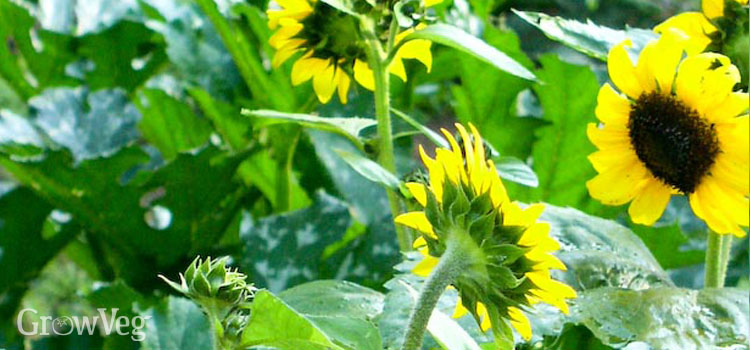
Sunflowers make good companions for summer sqush because they help attract pollinators

The best summer squash in the world are the ones you grow in your garden, harvest at the peak of tenderness and flavor, and then enjoy for the rest of the year. At our house, six or seven plants produce enough summer squash to eat fresh and stash in the freezer, often in combination with chopped basil and other odds and ends from the summer garden. In the garden and in the freezer, mixing things up is key to finding happiness in summer squash.

By Barbara Pleasant


Comments

I think the sunflowers look good as well as help with pollination - thanks I will try them this year. Would pot marigold be any good? I have just sewn my courgette, squash and marrow seeds ( pumpkin already done)- hope this is not too late but it has been so cold. I decided to put them in pots in the greenhouse rather than straight in the ground for a bit of a head start in the warm...
Comment by: Mary Palmer on Sunday, May 16, 2010

Mary, I think pot marigolds (calendula) go well with everything, but they're not tall enough to push their heads above a sea of squash foliage, whereas sunflowers can. I have pot marigolds naturalized in my garden. Perhaps we should do a feature on them!
Comment by: Barbara Pleasant on Sunday, May 16, 2010

No such thing as squash burnout here. We make up things like squash and ginger marmalade or squash and chili chutney. We eat squash all year round given half a chance.
Comment by: Geoffrey on Monday, May 17, 2010

Now if someone would just find a way to conquor squash bugs, those nasty adult varmits that arrive by the hundreds and kill the squash plants in their prime.
Comment by: Pat Roloff on Tuesday, May 18, 2010

Hi Geoffrey, would you be willing to share you squash and cholli chutney recipe by any chance?
Comment by: Laura on Friday, May 21, 2010

Here's the basis of the jam... http://www.bbcgoodfood.com/recipes/7565/marrow-and-ginger-jam and here is the basis of the chutney, just swap squash for toms!: http://blog.chilliupnorth.co.uk/2010/01/07/tomato-and-chilli-chutney/
Comment by: Geoffrey on Friday, May 21, 2010

I'm a newbe to growing veggies -- what does "kissing" the male squash mean. I'm only growing 2 plants in my garden but want the most fruit I cam get
Comment by: Brenda on Friday, May 21, 2010

Hi Brenda, Not to sound obscene, but barely touching the open part of the male flower to the inside of the female flower gets the pollen where it needs to go. If you get good weather for bees to work when your squash is blooming heavily, you may not need to bother.
Comment by: Barbara Pleasant on Friday, May 21, 2010

Any ideas about conquering squash bugs? I would rather not put any chemicals in my garden. Is there any household item or another type of plant that will chase them off?
Comment by: Audrey on Sunday, May 23, 2010

I start looking for squash bugs as soon as the weather warms, and drop them into a pail of soapy water. But more important is looking for brown egg clusters on leaves, which I scrape off with an old steak knife. Later in summer, when the squash is exhausted but the squash bugs are not, I pull up the plants, one each day, to force the bugs onto the surviving plants. I gather up the last ones in a sheet of clear plastic and let them cook in the sun. These maneuvers seem to keep the squash bugs at a manageable level. Good luck!
Comment by: Barbara Pleasant on Monday, May 24, 2010

I had left too much room between my potatoe rows and was struggling for space on my half allotment to grow everything I wanted to. One of the old guys who has being allotmenteering for over 30 years on the site said "well you could put your Squash and Courgettes down the middle of the potatoe rows as there is at least 2ft of room". The idea being that the Squash and Courgettes grow on top of the soil and the potatoes are underneath. Great I thought and went ahead now everything I have read says not to grow them together as they are not good companions. The proof will be in the eating, but how true do you think this is? Anyone else tried it?
Comment by: Bev Poppitt on Friday, June 04, 2010

Bev, in South America several crops are often grown with potatoes to provide them with some shade. And I know of no reason why squash and potatoes would not be compatible other than competition for sun. Looking at my garden, the potatoes will soon be winding down, while the squash is just getting going. Looks like the combination could work to me.
Comment by: Barbara Pleasant on Friday, June 04, 2010

Thanks Barbara, I thought it would be a good idea for those reasons too, and the potatoes would be well out the way when the Squash and Pumpkins are needing the space, but most seem to think that one stunts the growth of the other. Time will tell and thanks for responding!
Comment by: Bev Poppitt on Friday, June 04, 2010

I need more info on combating those rotten, ugly, infesting squash bugs. The idea above was good, but I want them GONE!!
Comment by: Dianne on Monday, June 07, 2010

Dianne, persistence is key. Every morning or as often as you can, go out early with gloved hands and collect the adult squash bugs in a pail of soapy water. The adults will be under leaves or near stems, close to the ground. Also scrape off the brick rid egg clusters from leaves. These measures will hold off the squash bugs long enough to get a good crop, but you must stay after them. Good luck! I squished several yesterday.
Comment by: Barbara Pleasant on Monday, June 07, 2010

About Squash bugs... I've already been infested this year! Doing some research, I've read that diatomaceous earth is highly recommended for squash bugs, garden fleas and cucumber beetles. It is considered organic so NO worry about chemicals! I bought a box over the week-end and will be spreading it today. I really hope this works! (I found diatomaceous earth in the pool-supply department at my local Lowes Home improvement store/ 25 lbs for $20. It is also used in pool and spa filters)
Comment by: Lea on Monday, June 07, 2010

I totally appreciate the advice, Barbara. When I found the bugs, there were literally hundreds of them. Picking that many off by hand (even in gloves) is creeping me out! I'll try starting very early in their growth to see if I can find them quicker. Yuck!! Thank goodness they are the only major bug I have to deal with so far. Knock on wood. I don't know much about that dirt that Lea mentioned. Let me know how it does. I may have to try that, too.
Comment by: Dianne on Monday, June 07, 2010

Im growing 3 different types of sqash. one of each....Is that ok for pollination? is eggplant a squash?
Comment by: Salgal on Tuesday, June 08, 2010

Salgal, as long as they are all "summer" squash -- zucchini (courgette), yellow squash, acorn or scallop -- they can cross-pollinate each other. Butternuts and other winter squash are of a different species, so they won't help with pollination of summer squash. Don't worry, because with four plants, once your plants start blooming heavily you will have plenty of squash.
Comment by: Barbara Pleasant on Tuesday, June 08, 2010

Thank you for the squash update. I just noticed that my red onions i planted on april 14th are about 14 inches tall and 5 of them have flower buds on them. Are they ready to pick? Should i cut the flowers off? they are only the size of a big scallion right now.
Comment by: Salgal on Thursday, June 17, 2010

@Salgal, onions that have flowers on will not be good for cooking with and should probably be left to flower as many beneficial insects love them.
Comment by: Jeremy Dore on Sunday, June 20, 2010

Salgal, we have onions pushing up flower buds too and have discovered that if we harvest as soon as we see the bud and then use promptly, the onions are FABULOUS! Sooo good to eat with freshly picked peas or peapods. I wouldn't pick if the bud has gone to flower.
Comment by: Ea on Monday, June 28, 2010

It is looking like I am going to have an abundance of zucchini this year, and thankfully I have not seen squash bugs. Can you give me some advice on the best way to freeze? Whole? Chopped? Freezer bags? Thanks.
Comment by: Audrey on Monday, June 28, 2010

Audrey, cut the squash into pieces of a size and shape you like for cooking, steam-blanch them for 3 minutes, and freeze in freezer bags. I like to add fresh chopped herbs or greens to add flavor to frozen squash. Try marinating and grilling squash slices before freezing them. You can also dry summer squash, which intensifies its flavor.
Comment by: Barbara Pleasant on Monday, June 28, 2010

Thanks for the ideas. I am definitely going to try freezing this year. Drying sounds interesting also. Do you use a standard dehydrator?
Comment by: Audrey on Monday, June 28, 2010

Yes, I have an Excalibur dehydrator, expensive to buy but easy to operate. I now dry more tomatoes than I can!
Comment by: Barbara Pleasant on Friday, July 02, 2010

Add a Comment

Add your own thoughts on the subject of this article:
(If you have difficulty using this form, please use our Contact Form to send us your comment, along with the name of this blog post.)

Your Comment:
Your Name:  
Your Email:   (We won't display this on the website or use it for marketing)
Protected by FormShield
Refresh
Listen
Please enter the characters shown on the image

Security Code:
(Please enter the code above to help prevent spam on this blog)

By clicking 'Add Comment' you agree to our Terms and Conditions


Link to this Page

Use this permanent URL to link if you would like to link to this post on your own website or blog:

Contact us to let us know and we will be happy to provide a link back to you

‘GrowVeg.com made designing my vegetable garden simple and enjoyable - I wish I’d had this years ago...’